
A sketch drawing is
your plan for exciting art.
A sketch drawing is your plan, your blueprint, for how you will make your idea exciting.
When you don’t plan and make decisions before you start, you condemn yourself to just copying what you see with all its boring details.
But, here’s the thing. A sketch drawing doesn’t need to be a huge undertaking. It doesn’t need to be fancy, intricate, or detailed... unless detailed is something you really, really, really enjoy.
Sketch drawings only need to show enough that you start your art feeling excited by what you plan to do and confident you can do it. I’ll show you what I mean in just a minute. But first...
A recipe for trouble
In my experience simply jumping into drawing or painting the first idea you have often ends in disappointment. At least it often did in my beginning years.
Because, in your mind everything about your idea looks great. It’s only when you start putting that idea on paper or canvas that...
You suddenly find the picture in your mind doesn't really tell you how you are going to make it all work.
You suddenly get ambushed by the problems you wished you’d seen before you started.
Problems you could have easily solved if you had done sketch drawings in the beginning. Believe me, I am speaking from experience here. Read my Gary’s Story page here – you’ll see exactly what I’m talking about
A sketch drawing is where successful art begins
Let’s say I recently discovered the work of artist Anne London and loved it so much I wanted to try some of her ideas in my own work.
What’s the best process for doing that?
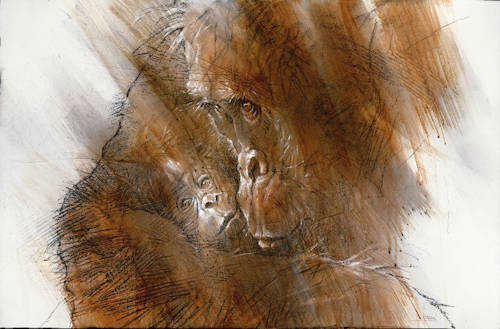
First, let me say I saw some of Anne’s work where I used to live in the U.S. While most of her work was quite large...
The thing that impressed me (like this piece above) was that it appears so simplified. Simple is very hard to do. It takes thought, planning and practice.
And the best place to begin that thought process and planning is in sketch drawings.
So, I would begin my thought process by asking myself: what do I like about Anne’s work that I would like to try in my own?
Two big things I like are:
1. How she really simplifies her subject and focuses on only the essential parts of the two faces. There was probably a lot more detail in the photograph she worked from, but she focused on the area that most interested her. And...
2. I like how she uses a well-designed dark value shape from which the faces emerge.
So the next crucial step in my creative planning is deciding how I can put those two qualities in my own work.
To answer that question, I pull out a 4B pencil, a kneaded eraser and some tracing paper and go to work. Sketching out design ideas to find an idea that excites me.
Wisdom that guides you another step closer to being an artist.
“I just had to send you an email to let you know that I am so fortunate, and happy that I subscribed.to your newsletter!! L.M.
“It is ALWAYS a pleasure reading your articles. Thanks so much! A.S.
 |
In my first sketch I try to create a strong, interesting value shape. I try to imagine how I could do that with an initial wash of watercolor or smear of pastel or thinned oil paint.
I keep trying to focus only on what I want to be the most important details of the bear’s head. This first sketch drawing is a good start, but I’m not excited enough by it to feel I’m done planning.
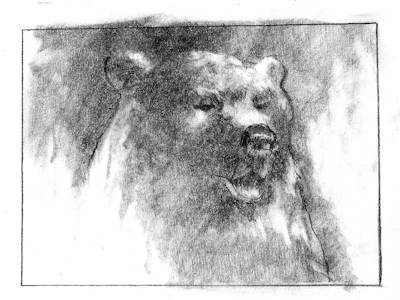
So, I take what I like about this sketch drawing and strengthen it in my next one.
In the second sketch below, I like the diagonal value shape better, but I feel it needs to be more interesting. I imagine how I can give the value shape a looser feel.
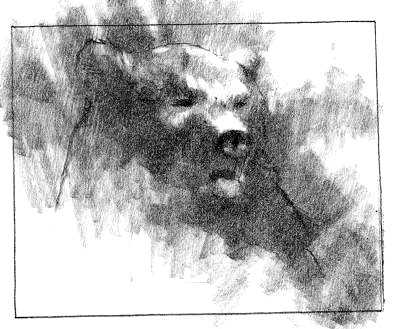
What if I used diagonal strokes like Anne used? I hold the pencil horizontally and use the length of the lead to try to simulate brush strokes. I like it better.
I imagine how I might subtly apply white paint over my value shape to create some simple highlights on its head.
I try a couple simple lines to define edges of its body. I want to keep this simple and only partially define the body. I’m liking how some parts almost disappear.
This second sketch drawing is making me feel more excited, so I take what I like about it and...
In my last sketch I keep the diagonal design, but here I try a little more definition in the face. I want to keep the value shapes loose and free. Since it’s only a sketch drawing, I can experiment. I can apply tone with my pencil and easily remove some or all of it with my kneaded eraser.
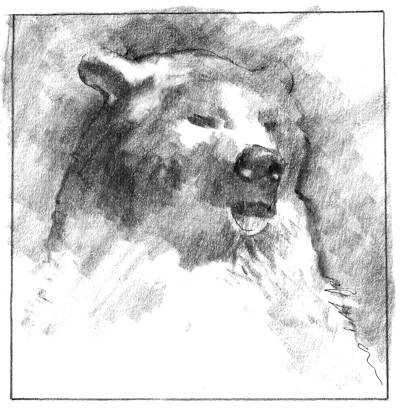
I try using bolder lines to define parts of its body. I try to imagine how that will look over the first wash of color.
I'm excited by this last idea. It feels like I’ve got a plan.
NOTICE: All these sketch drawings were done about four inches high using tracing paper, a 4B pencil and a kneaded eraser.
Notice too that not only did the idea and its details and values evolve during this sketching process, but also the shape of the proposed art.
That’s why sketch drawing is so valuable. You not only refine your idea, you also refine your drawing, design, imagination and simplifying skills when it’s easiest to practice them.
In Addition...
I write about all those things and more in my weekly newsletter, because they are the bedrock fundamentals of good art. This is what subscriber Ray Braun recently told me:
“I really like your teaching in that you don't teach gimmicks and tricks... but your actual THINKING behind the process.”
|
|
Copyright Gary Gumble 2026 All rights reserved About Privacy Policy Terms of Use Contact
4 Place Alexandre Laissac, 34000 Montpellier, France