Online Art Drawing Lessons
I developed these art drawing lessons, because in the beginning years as you learn to draw or paint, your main focus is usually just trying to control the medium you are using. If you can also get a decent likeness of your subject, you consider the effort a success.
Learn to Hear the Music

I compare these beginning years of art to the time many years ago when my wife and I took ballroom dance lessons.
Initially, I was so focused on getting the steps right (and not stepping on her toes) that I did not even hear the music.
It wasn’t until I got more comfortable with those first basic steps that I could hear the music and begin to move my feet in time to the beat.
These art drawing lessons are meant to help you begin to hear the music.
They are a combination of seeing, drawing and painting lessons that are not taught in most fine art classes or workshops, where the sole emphasis is usually on painting technique.
Now, I’m not saying that technique isn’t important. It is.
But, if you want to progress beyond the beginning stage, you need to learn the absolutely essential basic art drawing lessons of which technique is only one part.
You will progress faster and be much happier with your results when you take to heart the three S’s: See, Simplify and Structure.
Start to See
By this I mean two things:

To reach your dream for your art, you need to develop and encourage your inner eye, your imagination. You need to begin to see and paint your subjects the way they could be, not necessarily the way they actually are.
The problem is in the beginning years, it is so easy to get hooked on painting from photographs and end up only painting what is in the photograph.
I went through this stage in my beginning years and I see it in the work of many aspiring artists.
But, I have to tell you, in the 40 years I've been doing art, I've learned the most satisfying art to do and the most satisfying art for someone to look at contains imagination and visual surprise.
Encouraging your imagination is one of my absolute goals in every art drawing lesson I teach.

In order to more easily draw and paint our world and the complex things in it, it is important to see the world as simple shapes.
To give you an example of what I mean, take the human head. If you train yourself to see a head first as a simple egg shape, you can more easily start your drawing of it.
Then you can use your knowledge of how light and shadow appear on an egg to help you simplify the light and shadow on the head or face. That’s what I’ve done in the art below.
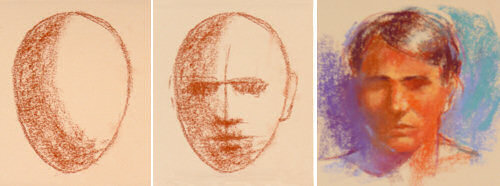
If you go further and add some imagination to the painting, you get something more unique.
Start to Simplify
Whether you paint from life or from a photograph, there is detail everywhere. So, you need to remember that what you don’t put in your painting is just as important as what you do.
It is the job of the artist to decide what the painting needs.
Artist Bill Hosner has said, “Ignore the obvious, paint the necessary”.
Knowing which details to eliminate and which to keep can help you create a more exciting piece of art.
Look at the photograph of the Galway harbor boats. There is detail everywhere, not all of which is necessary for a successful painting.

In practically every art drawing lesson I teach, I stress the importance of focusing on the essential details. The rest can be eliminated or changed. If you do that and add a dollop of imagination, you can paint the boats the way you want them to look.
And painting them as I’ve shown is only one of many ways of depicting them. Every artist will have a different opinion of which details are essential.
Start to Structure
In order for a good idea to be turned into a good piece of art, the
artist must create an interesting structure or arrangement of the
elements in it, in other words a good design.
Ignoring structure in your painting is like trying to build your dream house without any blueprints. You have a vision of what you want it to look like, but how do you get there without plans?
Too often beginning painters rely on photographs to paint from. They simply reproduce whatever is in the photograph.
Instead, in any art drawing lesson, you should first ask yourself: who or what is the star of your picture? What is most important? What do you want the viewer’s eyes to see first?
The rest of your painting then becomes the supporting cast, there to be interesting but never to overshadow the star.
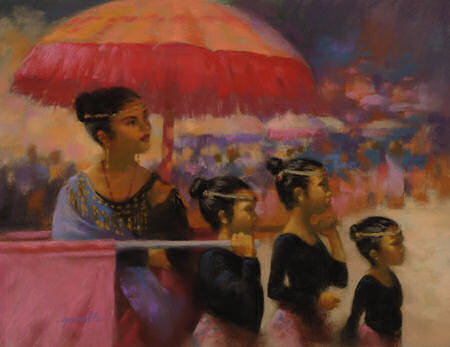
The star of my painting, Filipinas, is the tall girl on the left.
I made sure she is where your eye goes first, and I accomplished that several ways. I made her head stand out by creating a light background behind it.
The fringe on the umbrella and the umbrella pole draw your eye and frame her head.
And of the four figures, she has the most detail in terms of jewelry and spangles.
From my star your eye travels to the right until it reaches the youngest girl. From there I lead your eye into the background.
Notice I created a diagonal of suggested people and umbrella shapes in the background to lead your eye back to my star.
Creating structure like this is very important to the success of your painting and is another thing I strongly emphasize in all the art drawing lessons I teach.
Copyright Gary Gumble 2023 All rights reserved About Privacy Policy Terms of Use Contact www.beginningartist.com 27 rue Roucher, 34000 Montpellier, France